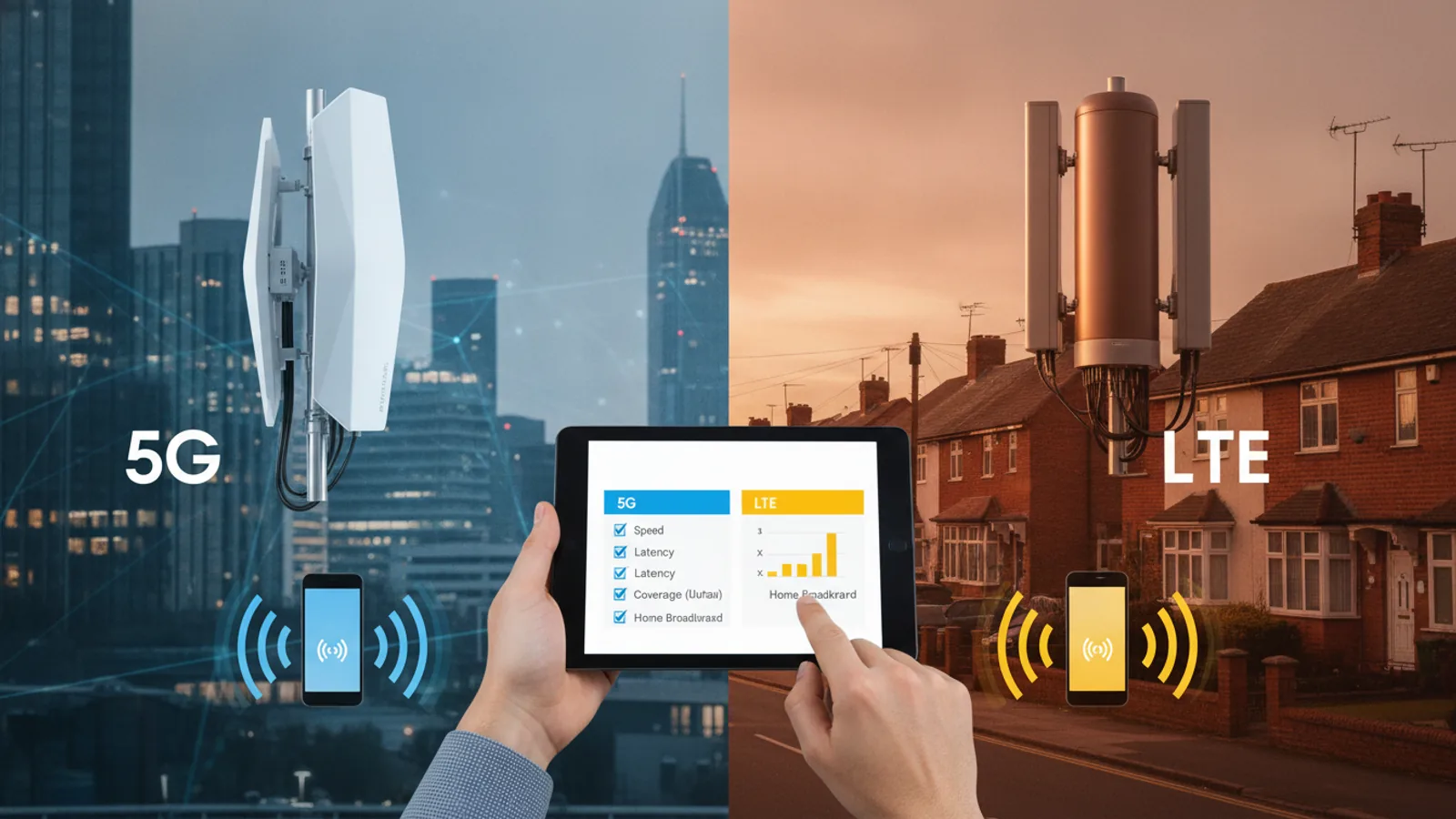
5g vs Lte: Which Should You Choose?
Head-to-head comparison
Overall winner: 5G for its vastly superior speed, responsiveness, and future-proof technology.
For users in most UK towns and cities, 5G is the clear choice in 2026, delivering a transformative leap in mobile performance for everything from gaming to 4K streaming. However, LTE remains the undisputed champion for universal coverage and reliability, making it a perfectly viable and often more practical option for those in rural areas or anyone whose daily needs don't require bleeding-edge speed.
Head-to-Head Scorecard
5g vs Lte: Key Differences
Understanding the 5G vs LTE debate is about recognising a generational leap in technology, not just a minor upgrade. LTE, or Long-Term Evolution, is the technology that made reliable mobile internet the norm under the 4G banner. It’s the established, dependable network that powers most of our daily browsing, streaming, and app usage. 5G, the fifth generation, is its successor, engineered from the ground up to deliver three core improvements: significantly faster speeds (eMBB - enhanced Mobile Broadband), near-instantaneous responsiveness or low latency (URLLC - Ultra-Reliable Low-Latency Communication), and the ability to connect a massive number of devices simultaneously (mMTC - massive Machine-Type Communications).
Think of it like upgrading from a standard ADSL broadband connection to full fibre. While LTE is fast enough for most things, 5G opens the door to new possibilities like seamless 4K/8K streaming on the go, competitive cloud gaming without lag, and a more robust connection in packed places like stadiums or train stations. As we move through 2026, the question is less about which is technically better (it's 5G, unequivocally) and more about which provides the best experience based on your location, device, and what you actually do online.
Measurement
Speed & Performance
Speed is the most dramatic and easily understood difference between 5G and LTE. While a strong LTE (often called 4G+) connection can provide respectable download speeds of 30-100 Mbps, it is simply outclassed by 5G. In most UK urban areas in 2026, a typical 5G connection delivers speeds between 150-400 Mbps, with potential peaks soaring much higher in areas with optimal infrastructure.
What does this mean in practical terms? Downloading a full-length HD film on LTE might take several minutes; on 5G, it can be done in under a minute. This performance boost transforms the user experience. Large app updates complete in seconds, high-resolution photos upload to the cloud almost instantly, and streaming 4K video is effortless, with no buffering. For home broadband users, a strong 5G signal can genuinely compete with and even surpass many entry-level fibre broadband packages, offering a viable, wire-free alternative. While LTE is perfectly adequate for web browsing, social media, and standard HD video, 5G’s performance is in a completely different league.
Measurement
Latency & Gaming Experience
Latency, often referred to as 'ping', is the delay between you sending a signal and receiving a response. It’s the measure of a network's responsiveness, and it’s where 5G truly shines. LTE networks typically have a latency of around 30-50 milliseconds (ms), which is fine for most activities but can be a noticeable hindrance in real-time applications. 5G technology is designed to slash this delay, with real-world latency often dropping below 10ms and theoretical potential for as low as 1ms.
This dramatic reduction is a game-changer for several key uses. For online gamers, lower latency means less lag, giving a critical competitive edge where split-second reactions matter. It makes cloud gaming services like Xbox Cloud Gaming or GeForce NOW feel almost as responsive as playing on a local console. Beyond gaming, low latency improves video calls by reducing the awkward delay between speakers and paves the way for future technologies like augmented reality (AR) and remote-controlled robotics, which depend on an instantaneous connection. While LTE's latency is acceptable, 5G's near-instant responsiveness creates a palpably snappier and more immediate-feeling internet experience.
Measurement
Coverage & Availability
This is the one area where the mature, established LTE network still holds a decisive advantage. UK mobile operators have spent over a decade building out their 4G/LTE networks, resulting in coverage that reaches over 99% of the population. You can be confident of getting a reliable LTE signal in almost every city, town, village, and along major transport routes across the country.
5G coverage, while expanding at an impressive pace, is not yet as ubiquitous. By 2026, it is widely available across all major cities and a growing number of towns. However, it can still be patchy. You might have a strong 5G signal in a city centre but lose it in the suburbs or find it doesn't penetrate deep inside large buildings as effectively as LTE signals. In rural and remote areas, LTE is often the only available option for high-speed mobile data. All 5G-enabled phones seamlessly fall back to the LTE network when 5G is unavailable, so you're never left without a connection. However, if your primary concern is having a dependable signal wherever you go, LTE's comprehensive national footprint remains unmatched.
Measurement
Network Capacity
Ever noticed your phone’s internet slow to a crawl in a crowded place like a football stadium, concert, or busy train station? That’s network congestion. LTE networks have a finite capacity and can become overloaded when too many people try to connect at once in a small area. 5G was specifically designed to solve this problem.
Thanks to more efficient use of radio spectrum and technologies like beamforming, a 5G network can handle a vastly greater number of connections simultaneously—up to a million devices per square kilometre. This massive capacity means that even in the most densely populated areas, 5G connections remain fast and stable. This is not only beneficial for smartphone users in a crowd but is also the critical technology underpinning the growth of the Internet of Things (IoT), enabling smart cities where countless sensors, vehicles, and devices can all communicate reliably at the same time. For the end-user, it simply means a more consistent and dependable high-speed connection, no matter how busy their surroundings are.
Measurement
Future-Proofing
When choosing a mobile technology or a new device in 2026, it's wise to consider the future. LTE is a fantastic, mature technology, but it represents the peak of the previous generation. It will continue to be a vital service for many years, but all new network development, innovation, and investment from mobile operators is focused squarely on 5G.
Choosing 5G means you are investing in the platform that will support the next decade of technological advancement. The applications that will define our future—from autonomous vehicles and advanced telehealth to immersive AR experiences and truly smart homes—will be built on the speed, responsiveness, and capacity of 5G networks. Opting for a 5G-capable phone and plan ensures your device will be able to take full advantage of these new services as they roll out. While an LTE device will continue to function perfectly well for core tasks, it will be locked out of this next wave of innovation. For long-term relevance and capability, 5G is the only logical choice.
Choose 5g If...
- You live, work, or commute in an area with strong 5G coverage. You can use network coverage checkers to verify this before committing to a plan.
- You're a serious mobile or cloud gamer. The ultra-low latency provides a tangible competitive advantage and a much smoother experience.
- You regularly stream video in 4K or higher resolutions. 5G handles high-bitrate streaming without any buffering or loss of quality.
- You need a high-speed home broadband alternative. 5G home broadband can offer fibre-like speeds without the need for a physical line installation.
- You want to be ready for the future. Investing in a 5G device and plan ensures you won't miss out on the next wave of mobile technology.
- You frequently download or upload large files. The speed difference will save you significant amounts of time.
Choose Lte If...
- You live in a rural or remote area with limited or no 5G coverage. LTE will provide a more consistent and reliable connection.
- Your absolute top priority is network availability. You need a signal that works virtually everywhere across the UK.
- You are on a very tight budget. While 5G is now standard on many plans, you may find cheaper, LTE-only tariffs or hardware options.
- Your internet usage is light. If you mainly browse websites, use social media, send emails, and stream standard HD video, LTE is more than capable of meeting your needs.
- You are using an older, non-5G smartphone and don't plan to upgrade soon. You won't be able to access 5G networks anyway, so focusing on a good value LTE plan makes sense.
Final Verdict: 5g vs Lte
In the 5G vs LTE comparison for 2026, the technological victor is clear: 5G is a superior network in almost every measurable way. Its incredible speeds, near-zero latency, and massive capacity represent a true generational leap, fundamentally improving the mobile internet experience and enabling a new ecosystem of connected technologies.
For the majority of consumers, especially those upgrading their phone or broadband in an urban or suburban location, choosing 5G is the most logical and forward-thinking decision. It provides the best performance available today and ensures you're prepared for the applications of tomorrow.
However, this doesn't render LTE obsolete. Far from it. LTE remains the backbone of UK mobile connectivity, a reliable and robust workhorse with a coverage footprint that 5G will take years to fully replicate. For individuals in areas yet to receive strong 5G service, or for those whose needs are amply met by today's speeds, LTE offers fantastic value and unparalleled dependability. The choice, therefore, hinges on your specific location, usage habits, and desire to be on the cutting edge of technology.
5g vs Lte: Which Should You Choose? FAQ
Do I need a new phone to use 5G?
Yes, you absolutely do. 5G technology requires a specific modem and antenna design that is only included in 5G-compatible smartphones and devices. An older 4G/LTE phone cannot connect to a 5G network, even if you are in a coverage area and have a 5G plan.
Will LTE be turned off or phased out soon?
No, not for a very long time. The LTE network is critical infrastructure that will co-exist with 5G for many years to come. It serves as the essential fallback layer for all 5G devices when they move out of a 5G coverage zone and will continue to be the primary network for millions of users and IoT devices for the foreseeable future.
Is 5G home broadband a good replacement for fibre?
It certainly can be. In areas with a strong, stable 5G signal, 5G home broadband can deliver speeds that are competitive with, or even better than, many Fibre-to-the-Cabinet (FTTC) packages. It's an excellent option if you're unable to get a fibre installation, or if you want a simpler setup without a landline. However, performance can be more variable than a fixed line, depending on network congestion and signal strength at your property.
Does 5G use more battery than LTE?
In the early days of 5G, it could drain batteries more quickly as the modem worked harder to find and maintain a signal. However, by 2026, both phone hardware and network software have become much more efficient. Modern 5G phones use "smart data" modes that automatically switch between 5G and LTE to conserve power. While intensive tasks on 5G (like downloading a huge file) will use more power due to the modem running at full tilt, for general use, the difference in battery life is now minimal.
Are there any health concerns with 5G technology?
No. Major international health organisations, including the World Health Organization (WHO) and Public Health England, have stated that there is no established evidence that 5G technology poses a risk to human health. 5G signals use non-ionising radio waves, similar to previous mobile generations, Wi-Fi, and TV broadcasts, and operate well within internationally agreed safety guidelines.