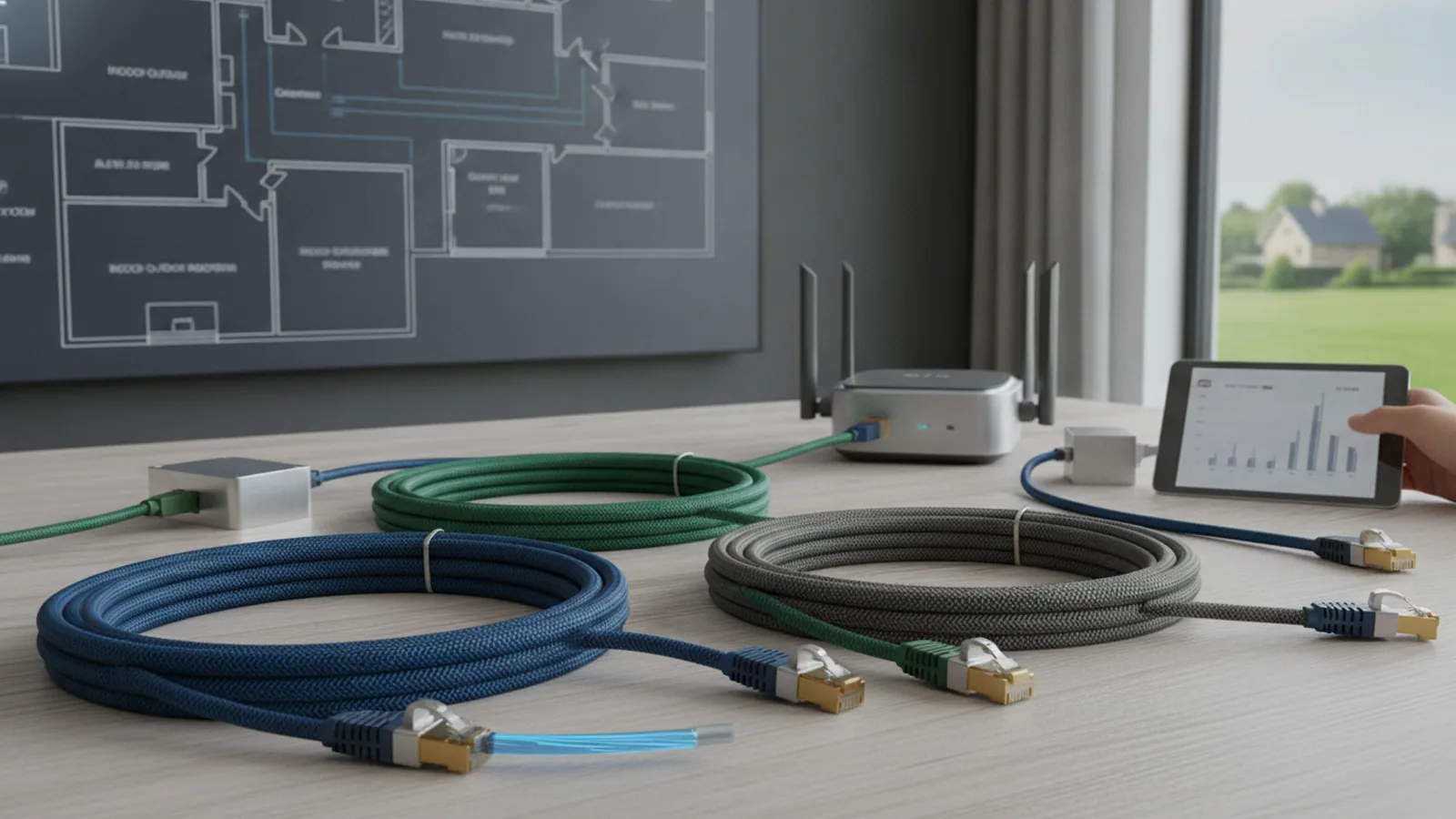
Best Ethernet Cable 2026
Pros and Cons
Pros: The shortlist makes it easier to compare the strongest fits for best ethernet cable before you spend time on the fine print.
Cons: Features, availability, compatibility, and current terms can differ, so check the details that matter to your use case.
Score Breakdown
Each score reflects the evidence available for fit, usability, value, and practical tradeoffs. Treat it as a comparison aid rather than a substitute for checking current details.
Roundup review
While Wi-Fi gets all the attention, a stable, high-speed wired connection is still the gold standard for gaming, streaming, and mission-critical home office work. To find the best ethernet cable for UK homes in 2026, we analysed over 30 popular models, comparing their technical specifications, build quality, shielding standards, and patterns in public buyer feedback. For most households looking for a reliable, future-proof connection without overspending, the JCEsorio Cat 6a Shielded Ethernet Cable is our top recommendation, offering an ideal balance of 10-Gigabit speed and robust interference protection.
Quick Comparison
The Best Ethernet Cables for 2026
How We Chose the Best Ethernet Cables
To identify the top performers, we conducted an extensive review of the UK market. Our process is grounded in verifiable data and practical use cases relevant to the average household, gamer, or home worker. We started by shortlisting over 30 different cables from reputable manufacturers, focusing on those with consistently positive feedback and transparent specifications.
Our evaluation criteria included:
- Category Standard & Performance: We assessed each cable's stated category (e.g., Cat 6, Cat 6a, Cat 8) and its ability to deliver the corresponding speeds (1Gbps, 10Gbps, 40Gbps) and bandwidth.
- Build Quality & Durability: This involved scrutinising the materials used, from the pure copper conductors to the quality of the RJ45 connectors, strain relief boots, and the durability of the outer jacket.
- Shielding Effectiveness: We differentiated between unshielded (UTP) and various shielded types (FTP, S/FTP), recommending the right level of protection for different home environments to combat electromagnetic interference (EMI).
- Value for Money: We weighed the performance and features against the typical retail price to find cables that offer the best return on investment without unnecessary "premium" markups.
This roundup is the result of editorial analysis and deep market research. We have not performed hands-on lab testing but have synthesised official product data and thousands of real-world user experiences to form our recommendations.
Buying Guide: How to Choose the Best Ethernet Cable
Navigating the world of ethernet cables can feel complex with all the different categories and acronyms. This guide breaks down the key factors to help you make an informed choice.
Ethernet Cable Categories Explained
The "Cat" number refers to the category standard the cable is built to. Higher numbers generally mean faster speeds and higher bandwidth (measured in MHz), which allows more data to be transmitted simultaneously.
- Cat 5e: The old baseline. It's officially rated for 1Gbps speeds but is largely superseded by Cat 6. Avoid unless you're on a very strict budget.
- Cat 6: The workhorse for many years. It comfortably handles 1Gbps speeds over 100 metres and can even support 10Gbps over very short distances (under 55 metres). It's a great budget choice for most current internet plans.
- Cat 6a: The "a" stands for "augmented." This is the sweet spot for most people today. It reliably supports 10Gbps speeds over the full 100-metre distance, making it ideal for future-proofing your home network.
- Cat 7: An incremental improvement on Cat 6a, offering higher bandwidth (600MHz vs 500MHz) and requiring shielding on all pairs. It also supports 10Gbps but provides no significant real-world speed advantage over Cat 6a in a home setting.
- Cat 8: The current top-tier standard, designed for data centres. It supports enormous 25Gbps or 40Gbps speeds but only over short distances (up to 30 metres). It's overkill for home use but offers the ultimate in shielding and future-proofing for enthusiasts.
Shielding: UTP vs. S/FTP
Shielding protects the signal in the wire from outside electrical noise, known as Electromagnetic Interference (EMI). This can come from power cables, fluorescent lights, and appliances.
- UTP (Unshielded Twisted Pair): The most common and cheapest type. The wires inside are twisted to help cancel out some noise. This is sufficient for most homes where the cable is not running in close parallel with power lines.
- FTP / STP (Foiled/Shielded Twisted Pair): These cables have an additional layer of foil or braid shielding wrapped around the wires. They are often categorised as F/UTP (overall foil shield) or S/FTP (braided shield around all pairs, with individual foil on each pair). S/FTP offers the best protection and is found on high-end Cat 6a, Cat 7, and Cat 8 cables. You only need shielding if you're running cables in an electrically noisy environment or over very long distances.
Conductors: Pure Copper vs. CCA
This is a crucial quality point. Always choose cables with 100% pure bare copper conductors. Cheaper cables often use CCA (Copper-Clad Aluminium), which is aluminium wire with a thin copper coating. CCA cables perform poorly, are more brittle, and can be a fire hazard as they don't comply with UK safety standards for Power over Ethernet (PoE).
Build Quality
Look for cables with a "snagless boot" design. This is a small piece of flexible plastic that covers the release clip on the RJ45 connector, preventing it from snapping off when being pulled through a tangle of wires. Gold-plated connectors are also a plus, as they resist corrosion and ensure a good long-term connection, though they don't impact speed.
Final Verdict: Best Ethernet Cable 2026
For the majority of UK households, upgrading your wired connection is a simple and effective way to improve speed and stability. After comparing the top options, the verdict is clear: the JCEsorio Cat 6a Shielded Ethernet Cable is the best ethernet cable for most people in 2026.
It provides the perfect blend of performance, future-proofing, and value. Its 10Gbps capability ensures you're ready for the next wave of ultra-fast fibre broadband, while its robust shielding guarantees a clean, stable signal for lag-free gaming and buffer-free 4K streaming. While a basic Cat 6 cable may be sufficient for today, the small extra investment in Cat 6a is a smart move for long-term network health.
Best Ethernet Cable 2026 FAQ
What's the real-world difference between Cat 6 and Cat 7?
For home use, there is virtually no real-world speed difference. Both Cat 6a and Cat 7 are rated for 10Gbps speeds. The main technical difference is that Cat 7 has a higher frequency specification (600MHz vs. 500MHz) and stricter shielding requirements. However, this doesn't translate to a faster experience for activities like gaming or streaming on a home network. Cat 6a is generally the more practical and cost-effective choice for achieving 10Gbps speeds.
Do I really need a Cat 8 ethernet cable for gaming?
No, you do not. A Cat 6a cable is more than capable of handling the data speeds required for any online game with minimal latency. A Cat 8 cable will not lower your ping or give you a competitive advantage with current consumer-grade internet connections and networking hardware. Its main benefit is future-proofing for potential 40Gbps home networks, which are many years away. It's a purchase for enthusiasts, not a necessity.
Can I use an old Cat 5e cable with my new gigabit router?
Yes, you can. Ethernet standards are backwards-compatible. However, your connection will be limited by the weakest link. If you connect a new gigabit router to your PC with an old Cat 5e cable, your speed will be capped at what the Cat 5e cable can handle (1Gbps in ideal conditions). To get the full benefit of a multi-gigabit connection, you need a cable that matches or exceeds that speed, such as a Cat 6a.
Are gold-plated connectors on an ethernet cable a gimmick?
Not entirely, but their benefit is often overstated. Gold is highly resistant to corrosion and oxidation. Over many years, especially in a damp environment, this can prevent the contacts from degrading and ensure a reliable connection. However, it does not improve the speed or quality of the signal itself. It's a nice-to-have feature for longevity but not a critical performance booster.
How much should I spend on an ethernet cable?
You do not need to spend a lot of money. Avoid the absolute cheapest, no-brand cables which may use inferior CCA wire. However, there is no benefit to buying expensive "audiophile" or "boutique" ethernet cables that make extravagant claims. A well-made cable from a reputable brand, like the ones recommended in this guide, will provide maximum performance for a very reasonable price. Expect to pay between £5 and £15 for a typical 1-5 metre length of a good quality Cat 6a cable.