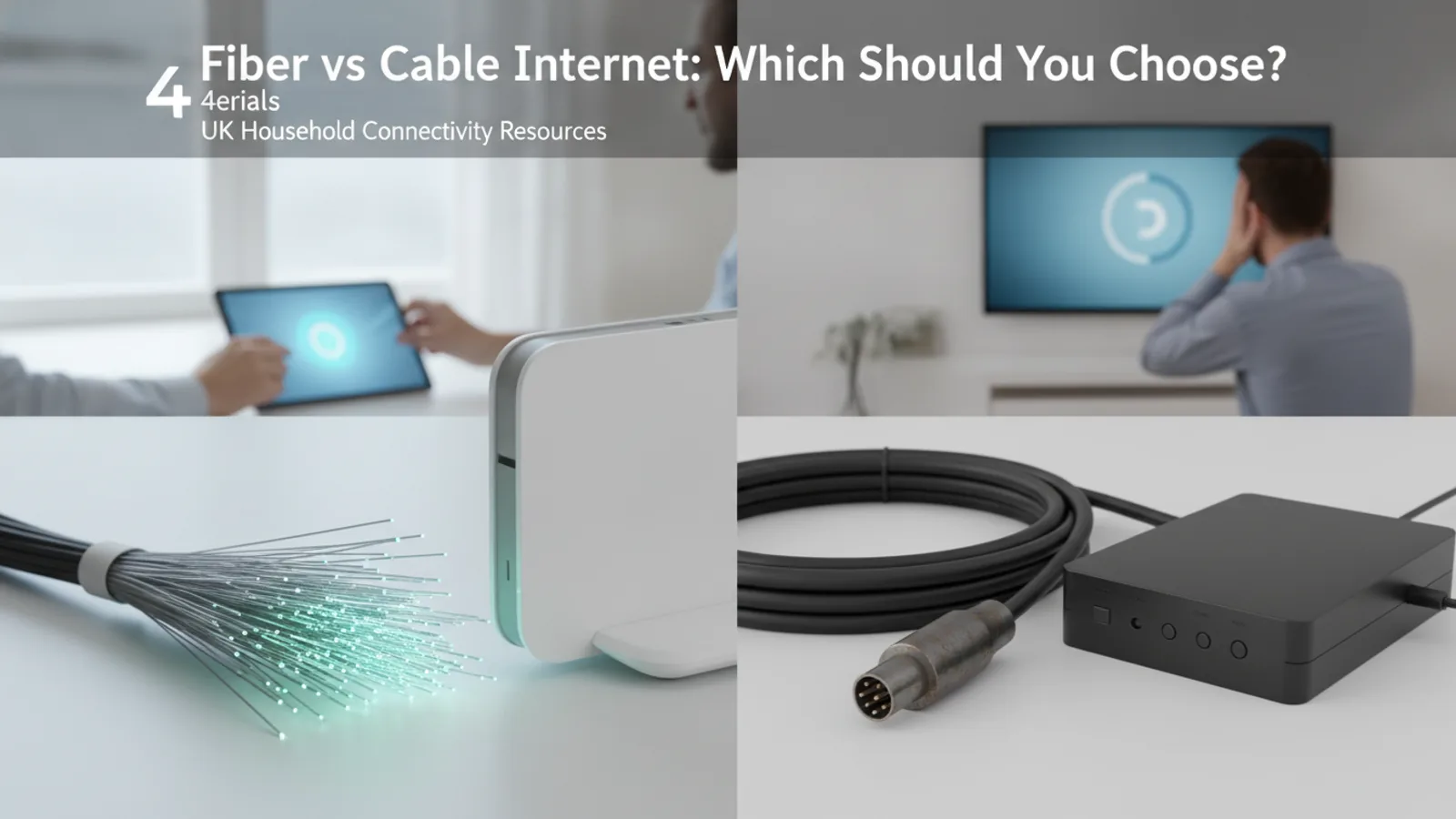
Fiber vs Cable Internet: Which Should You Choose?
Head-to-head comparison
Overall winner: Fiber for its superior symmetrical speeds, reliability, and future-proof technology.
Fiber optic broadband is the undisputed champion for performance, offering identical upload and download speeds perfect for demanding tasks like gaming, streaming, and working from home. However, its availability is still growing. Cable internet, primarily from Virgin Media in the UK, is a fantastic and widely available alternative, providing excellent download speeds that are more than sufficient for most households.
This comparison is based on our extensive research of provider specifications, network technology, customer feedback patterns, and Ofcom reports. We have not performed direct hands-on speed tests for this guide.
Head-to-Head Scorecard
Fiber vs Cable Internet: Key Differences
At first glance, fiber and cable both promise 'superfast' or 'ultrafast' internet, but the technology powering them is fundamentally different. Understanding this difference is key to choosing the right connection for your home.
Fiber optic broadband, often called 'full fiber' or FTTP (Fibre to the Premises), uses thin strands of glass to transmit data as pulses of light. This light travels at, well, the speed of light, over a dedicated line running directly to your home. This modern infrastructure is incredibly efficient, allowing for breathtaking speeds and equal performance for both downloading and uploading data.
Cable internet, on the other hand, uses the same coaxial copper cables that have traditionally delivered television services. Most cable networks today are Hybrid Fibre-Coaxial (HFC). This means a fiber optic line runs to a local cabinet in your neighbourhood (your street or estate), and a coaxial cable completes the journey from the cabinet to your house. While this setup delivers fantastic download speeds, the copper cable portion is a bottleneck. It's shared with your neighbours and is far less efficient at uploading data than it is at downloading.
The main takeaway? Fiber is a direct, dedicated, and more advanced connection. Cable is a powerful but older hybrid system that shares its final leg of the journey with other homes, impacting upload speeds and peak-time performance.
Measurement
Speed (Download & Upload)
When we talk about internet speed, we're really talking about two different things: download speed and upload speed. Download speed affects how quickly you can stream movies, load websites, and receive files. Upload speed governs how fast you can send emails with large attachments, back up photos to the cloud, or broadcast your video on a Zoom call.
Both fiber and cable can offer headline download speeds of 1Gbps (1,000Mbps) or more, which is more than enough for even the most demanding households to stream 4K content on multiple devices simultaneously. In this respect, it's a dead heat.
The real battle is won on uploads. This is where fiber's key advantage—symmetrical speeds—comes into play. A 1Gbps fiber plan typically gives you 1Gbps download AND 1Gbps upload. This is a game-changer for modern internet use.
Cable internet is asymmetrical. Its upload speeds are a small fraction of its download speeds. For example, Virgin Media's Gig1 plan offers a download speed of 1,130Mbps, but the upload speed is just 104Mbps. While that's still fast, it's over ten times slower than the download rate and can become a bottleneck if you're working from home, uploading large video files, or have multiple cloud backup services running.
Measurement
Reliability & Latency
A fast connection is useless if it's not stable. Reliability refers to the consistency of your connection, while latency (or 'ping') is the delay between you sending a signal and it being received. Low latency is crucial for responsive online gaming and clear, lag-free video calls.
Fiber optic cables are made of glass, making them immune to the electromagnetic interference that can affect copper coaxial cables. The signal doesn't degrade as much over distance, and because you have a dedicated line to the exchange, your performance isn't directly impacted by what your neighbours are doing online. This results in a highly stable connection with consistently low latency, often below 10ms (milliseconds).
Cable's HFC network is more susceptible to issues. The shared coaxial line from the cabinet to the homes in your area means that during peak times (typically 7-11 pm), when everyone is streaming and browsing, you can experience a noticeable slowdown. This network congestion can lead to less consistent speeds and higher latency spikes compared to a full fiber connection. While cable latency is still good, it's generally a little higher than fiber and can be less consistent.
Measurement
Availability & Installation
The best internet in the world doesn't matter if you can't get it. This is where cable currently has an edge over full fiber in the UK.
Virgin Media's cable network has been established for decades and passes over 16 million UK homes. This makes it a widely available option for superfast broadband in many urban and suburban areas. If you're looking for speeds faster than standard copper broadband (FTTC), there's a good chance Virgin Media is an option for you.
Full fiber, while expanding rapidly, is a newer technology. The rollout, led by Openreach (serving providers like BT, Sky, and TalkTalk) and alternative networks ('alt-nets') like CityFibre and Hyperoptic, is a massive infrastructure project. While coverage is growing by millions of homes each year, there are still large parts of the country where it is not yet available.
Installation can also differ. If your home has had cable before, installation can be a simple self-start kit. A new fiber connection always requires an engineer visit to run the new fiber optic cable into your home, which can sometimes be more complex, occasionally requiring minor external drilling.
Measurement
Value for Money
Determining value is about more than just the monthly price; it's about the performance you get for your pound. Both fiber and cable providers are highly competitive, especially for new customers.
Cable providers, especially Virgin Media, are known for aggressive introductory pricing and compelling bundles. You can often get gigabit-capable internet, a comprehensive TV package, and a home phone line for a price that looks very attractive compared to buying these services separately. For families who want an all-in-one entertainment package, these bundles can represent excellent value.
Fiber pricing has become much more competitive as the network has expanded. While top-tier multi-gigabit plans can be expensive, entry-level full fiber plans (e.g., 150Mbps) are often priced similarly to mid-tier cable or FTTC plans. The value here comes from the superior technology. For a similar monthly cost, you're getting a more reliable connection with significantly better upload speeds and lower latency. It's a premium product without necessarily carrying a huge premium price tag anymore.
However, for sheer bang-for-your-buck on download speed and bundled TV content, cable's promotional deals are hard to beat, especially if you aren't a power user who needs fast uploads.
Measurement
Future-Proofing
When you sign an 18 or 24-month contract, it's wise to consider which technology will best serve your needs not just today, but in two years' time and beyond.
Cable technology is impressive, but it is reaching the upper limits of what can be achieved over coaxial copper lines. While future standards promise multi-gigabit speeds, the fundamental limitations of asymmetrical performance and shared bandwidth will remain.
Fiber optic technology, however, is just getting started. The glass cables being installed today are capable of carrying vastly more data than current plans offer. Speeds of 10Gbps are already being trialled, and the theoretical limit is many times higher. As our demands for data grow—with 8K streaming, cloud gaming, virtual reality, and smart home ecosystems—a fiber connection ensures your home is ready for whatever comes next. Choosing fiber is an investment in the next decade of internet technology.
Choose Fiber If...
- You're a serious gamer: The ultra-low and stable latency gives you a competitive edge and a frustration-free experience.
- You work from home: Fast, symmetrical upload speeds make sending large files, participating in video conferences, and using cloud applications seamless.
- You're a content creator: Uploading high-resolution videos to YouTube or streaming on Twitch is significantly faster and more reliable.
- You have a large, busy household: With many people and devices all using the internet at once, fiber's reliability and capacity can handle the strain without breaking a sweat.
- You want the best possible connection: If you simply want the most technologically advanced, reliable, and future-proof internet available, and it's offered at your address, fiber is the clear choice.
Choose Cable Internet If...
- Full fiber isn't available yet: For millions of homes, cable is the fastest and best option available right now.
- Your priority is fast downloads: If your main activities are streaming Netflix, downloading games, and browsing the web, cable's gigabit download speeds are exceptional.
- You want a TV and broadband bundle: Cable providers often have the most comprehensive and best-value bundles, combining hundreds of channels with fast internet.
- You're a budget-conscious heavy user: Introductory offers can make cable a very cost-effective way to get ultrafast download speeds for your family.
- Your upload needs are modest: If you don't regularly upload large files or have multiple high-quality video calls running at once, cable's asymmetrical speeds will likely not be a limitation for you.
Final Verdict: Fiber vs Cable Internet
While both technologies offer a massive upgrade over older copper phone lines, fiber is the technical winner and the superior choice for home broadband in 2026. Its symmetrical speeds, lower latency, and greater reliability make it the best-performing option for the demands of modern internet use, from gaming and remote work to running a smart home. It is also the most future-proof connection you can get.
However, this victory comes with a crucial caveat: availability. The choice between fiber and cable is often made for you by which service is physically available at your postcode. If you can't get full fiber, cable internet is an outstanding alternative. It provides world-class download speeds that will satisfy all but the most demanding power users and often comes in cost-effective bundles that are perfect for families.
Our advice is simple: use an online postcode checker. If a full fiber service from a provider on the Openreach or an alternative network is available, it should be your top choice. If not, and you can get Virgin Media's cable service, sign up with confidence knowing you're still getting one of the fastest and most capable connections in the country.