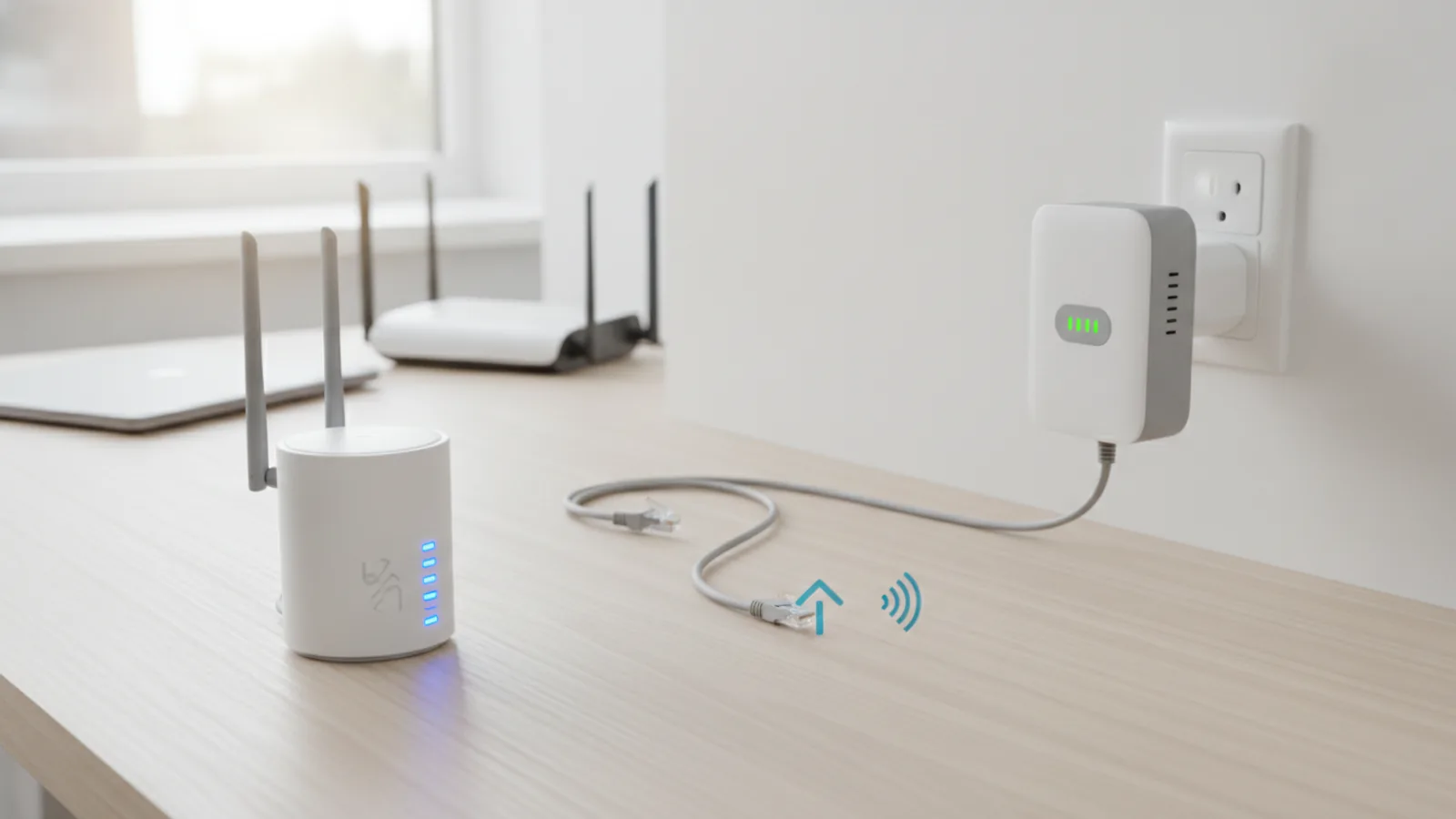
Wifi Booster vs Wifi Extender: Which Should You Choose?
Head-to-head comparison
Overall winner: Wifi Booster (specifically, a Mesh Wi-Fi system) for its superior performance, seamless coverage, and modern features.
While a Wifi Extender offers a cheap and simple fix for a single dead spot, its performance limitations are significant. For a truly reliable and fast whole-home network, a modern Wifi Booster, such as a mesh system, provides a comprehensive upgrade. Choose an Extender for a small flat with one tricky corner; choose a Booster for a larger home, multiple floors, or a family with many connected devices demanding consistent speed.
Head-to-Head Scorecard
Wifi Booster vs Wifi Extender: Key Differences
The confusion between a "Wifi Booster" and a "Wifi Extender" is one of the most common issues in home networking. Marketers often use the terms interchangeably, but for the purpose of making an informed choice, it's crucial to understand the technical distinction.
A Wifi Extender (also known as a repeater) is a simple device. It captures the existing Wi-Fi signal from your router and rebroadcasts it to a new area. Think of it like a relay runner. It takes the baton (your Wi-Fi signal) and runs it further, but it gets a little tired in the process. This act of receiving and transmitting on the same radio frequency often cuts the available bandwidth in half, leading to a significant drop in speed. Most extenders also create a new network name (SSID), like "HomeWifi_EXT," forcing your devices to disconnect from one and connect to the other as you move around your home.
A Wifi Booster, in its modern and most effective form, refers to a Mesh Wi-Fi System. This is a far more sophisticated solution. Instead of a single relay runner, a mesh system is like a team of intelligent communicators placed around your house. A main "node" connects to your modem (often replacing your old router), and several satellite nodes are positioned to create a wide, seamless web of coverage. These nodes talk to each other and your devices, intelligently routing internet traffic along the fastest, least congested path. The result is one single network name, strong signal everywhere, and minimal speed loss. It’s a complete network replacement, not just a patch.
In short, an extender is a cheap, simple fix for a single area that comes with a performance penalty. A mesh booster is a more comprehensive investment that solves poor Wi-Fi across your entire home.
Measurement
Routine Fit
How well does each solution fit into the routine of a modern British household? Today’s homes are not just about checking email in the study. We have 4K TVs streaming in the living room, kids online gaming in their bedrooms, multiple video calls for work, and a dozen smart devices from doorbells to thermostats all demanding a stable connection.
A Wifi Extender can struggle under this load. It creates a bottleneck. If you place it between your router and the living room TV, it might deliver a signal, but that signal is already weakened. Trying to stream 4K content while someone else is on a Zoom call through that same extender can lead to buffering, dropouts, and frustration. It patches one hole but can’t handle heavy, simultaneous traffic.
A Wifi Booster, as a mesh system, is designed for this exact scenario. Its multiple nodes share the load, and its smart routing ensures that high-priority traffic (like your video call) gets the bandwidth it needs. Because it creates a single, unified network, your phone can seamlessly switch between nodes as you walk from the kitchen to the garden without dropping a call. It adapts to the demands of a busy, connected family.
Measurement
Core Technology
The technology inside these devices is what truly separates them. A Wifi Extender relies on basic repeater technology. Most budget models are "half-duplex," meaning they cannot receive and transmit data at the same time on the same band. This is the technical reason for the infamous 50% speed cut. They are a simple amplifier, boosting everything, including interference.
A Wifi Booster (Mesh System) is a powerhouse of modern networking tech. Key features include:
- Multiple Access Points: Each node acts as its own access point, providing a strong signal in its vicinity.
- Intelligent Routing: The system constantly analyses traffic and signal strength to send your data on the most efficient path back to the modem.
- Dedicated Backhaul: More advanced mesh systems use a dedicated wireless band (or a wired Ethernet connection) for the nodes to communicate with each other. This "backhaul" channel means that the Wi-Fi bands used by your devices are not congested with system traffic, preserving your speed.
- Band Steering: The system automatically moves your devices to the best available frequency (2.4GHz for range, 5GHz for speed) to optimise performance.
- Seamless Roaming: Standards like 802.11k/v/r allow your devices to hop between nodes without any interruption, a feature most extenders lack.
Furthermore, mesh systems are at the forefront of new standards like Wi-Fi 6, 6E, and 7, which are designed to handle dozens of devices more efficiently.
Measurement
Ease of Use
When it comes to the sheer simplicity of the initial setup, the Wifi Extender has a clear advantage. For most models, the process is incredibly straightforward: plug the extender into a power socket near your router, press the WPS (Wi-Fi Protected Setup) button on both devices, and wait for them to pair. You then move the extender to a halfway point between your router and the dead zone. The entire process can take less than five minutes.
Setting up a Wifi Booster (Mesh System) is a more involved, albeit still user-friendly, process. It requires you to unplug your old router and replace it with the main mesh node. You then use a smartphone app to guide you through setting up your network name and password, and placing the satellite nodes around your home. While the apps from brands like TP-Link Deco, Eero, and Google Nest are excellent and make it easy, it is a bigger commitment than simply plugging in a small device.
However, it's worth noting that for long-term management—setting up guest networks, using parental controls, or monitoring device usage—the polished apps of mesh systems are far superior to the clunky web interfaces of most budget extenders.
Measurement
Value
Value is not just about the lowest price; it's about what you get for your money. In this category, the winner depends entirely on the scale of your problem.
A Wifi Extender offers exceptional value if your goal is narrowly defined. You can buy a perfectly functional extender for between £20 and £50. If all you need is to get a stable, low-bandwidth signal to a smart speaker or a laptop in an adjacent room, spending £25 to solve that problem is an undeniable bargain. The performance might not be perfect, but it achieves the specific goal for a minimal outlay.
A Wifi Booster (Mesh System) represents a much larger investment. A good entry-level two- or three-node system typically starts around £100-£150 and can easily climb to over £400 for high-performance Wi-Fi 6E models. However, the value here is in its completeness. For that price, you are not just patching a dead zone; you are replacing your entire network with a modern, powerful, and reliable system that will likely serve you for years to come. It solves not only today's dead zone but also prevents future ones as you add more devices. It is a solution to the problem of "bad Wi-Fi" as a whole.
Measurement
Buyer Confidence
This comparison is based on our editorial analysis of product specifications, manufacturer information, and widespread public buyer feedback patterns. A clear trend emerges in long-term satisfaction.
Buyers of Wifi Extenders often report mixed experiences. While many are happy with the low-cost fix, a significant number express frustration with connection drops, slower-than-expected speeds, and the hassle of managing a separate "_EXT" network. It is often seen as a compromise, a "good enough" solution that doesn't fully resolve the underlying issue of a weak core network. The initial satisfaction can wane as network demands increase.
Conversely, buyers of Wifi Boosters (Mesh Systems) consistently report very high levels of satisfaction. The overwhelming sentiment is one of relief. Users frequently comment that it "finally solved" years of Wi-Fi problems. The "set it and forget it" nature, combined with consistent performance across the entire property, creates a much more positive and confident ownership experience. While the upfront cost is higher, the investment is rewarded with a stable and frustration-free network, leading to better long-term buyer confidence.
Choose Wifi Booster If...
- You live in a medium-to-large home (over 1,500 sq ft) or a property with multiple floors.
- Your home has signal-blocking features like thick masonry walls or underfloor heating.
- You suffer from many Wi-Fi dead zones, not just one isolated spot.
- Your family has numerous connected devices (laptops, phones, tablets, smart home tech).
- You rely on high speeds for 4K/8K streaming, competitive online gaming, or frequent work-from-home video conferences.
- You value the convenience of a single, seamless Wi-Fi network name throughout your property.
- You are willing to invest more for a premium, reliable, and long-term solution to poor Wi-Fi.
Choose Wifi Extender If...
- You live in a smaller house or flat and have only one specific room or corner with a weak signal.
- Your budget is the primary factor, and you need the most affordable solution possible. - You only need to extend the signal for low-bandwidth tasks like web browsing, social media, or music streaming.
- You are not technically confident and want the absolute simplest plug-and-play setup.
- You understand and accept that your Wi-Fi speeds in the extended area will be significantly reduced.
- Your main router is already in a good, central location but its signal just falls short of one area.
Final Verdict: Wifi Booster vs Wifi Extender
For the vast majority of UK households struggling with inconsistent Wi-Fi in 2026, a Wifi Booster—specifically a modern mesh Wi-Fi system—is the definitive long-term solution. It addresses the fundamental problem of poor coverage with superior technology that is built to handle the demands of our device-heavy lives. It provides the speed, stability, and seamless coverage that makes your internet connection feel effortless, everywhere in your home.
That said, the humble Wifi Extender still holds a valuable and important niche. It is the undisputed champion of low-cost, targeted fixes. If your Wi-Fi is great everywhere except for the spare bedroom, an extender is a perfectly sensible and economical way to solve that single problem. Think of it as a plaster for a small cut; it's effective for a minor issue but inadequate for a more serious one.
Our final recommendation is to assess your frustration level. If you have one annoying dead spot, try an affordable Wifi Extender first. But if "the Wi-Fi is playing up again" is a common complaint in your home, save yourself the incremental hassle and invest in a quality Wifi Booster mesh system. It's the most effective way to solve the problem for good.
Wifi Booster vs Wifi Extender: Which Should You Choose? FAQ
Is a Wi-Fi repeater the same as a Wi-Fi extender?
Yes, the terms "repeater" and "extender" are generally used interchangeably in the consumer market. Both refer to a device that captures an existing Wi-Fi signal and rebroadcasts it to increase its range.
Will a Wi-Fi extender definitely reduce my internet speed?
Yes, in most cases. Traditional single-band or dual-band extenders must use the same radios to both receive the signal from the router and transmit it to your devices. This process, known as half-duplex communication, typically cuts the maximum potential bandwidth in half. While the signal will be stronger, the speed will be lower.
Can I use multiple Wi-Fi extenders in my home?
While you technically can, it is strongly discouraged. "Daisy-chaining" extenders (where one extender connects to another) degrades performance exponentially and can create a very unstable network. If you have multiple dead zones that require more than one device, a mesh Wi-Fi system is the correct and far superior solution.
Do I need to replace my router to use a booster or extender?
For a Wifi Extender, no. It is designed to work with your existing router. For a Wifi Booster (Mesh System), the main mesh node typically plugs directly into your modem and replaces your current router's function to create its own new, powerful network.
What about Powerline adapters? Where do they fit in?
Powerline adapters are another type of network extension solution. They use your home's electrical wiring to transmit the internet signal from your router to another room. A plug near the router connects via an Ethernet cable, and a second plug in the dead zone provides a new Wi-Fi access point or Ethernet port. They can be a great alternative to Wi-Fi extenders if the signal must pass through very thick stone walls, but their performance is highly dependent on the age and quality of your home's wiring.